Monday, September 13, 2010

Chapter 5: Yoyogi Koen (Park): The Daily Jog/Flog

Most days i have tried to run for exercise, and i am very lucky to be living less than a kilometer from Yoyogi Koen (Park) which is where the '64 Summer Olympics were held in Tokyo.  You can do speed work on the Olympic oval track, but there is a nicer stretch of park, larger, just to the north, and west of Meiji Shrine, a blog for another day and time.

The record-setting heatwave has made the move here challenging.  Most days require 2 or 3 showers and shirt changes. You just need to stand and walk a few steps, and the sweat pours out of you.  There is nothing good to write about it, and it seems that this heat and humidity will continue to just sit on top of Japan until i leave. Only one day has it been below 30C, when it rained as a weakening typhoon crossed over Honshu (the main island of Japan). Meanwhile, i glance at Vermont where the high temps are a good 18 degrees F or 10 degrees C cooler, and the leaves are already changing color in the mountains. Here, summer continues unabated. 

Here are pictures from my daily run with a few surprises for you blog followers of my J-life:
This is a typically narrow Japanese street that i run along. It is barely wide enough for a single car, but it is bidirectional believe it or not. This is the standard road in our neighborhood. Then the treasure below appears:
Just before i leave the street in the first photo, i run by this gem.  Occasionally, sporadically, you see signs of the old Tokyo. The style of houses that once were, and you just stop to pause and to admire.  Maybe the houses are not practical (no central heat or air) but the aesthetic is so beautiful, and it is increasingly harder to fine such homes.  You have on either side of this place the typical low-rise apartment building, non-descript, rather bland facade, and it just further accents how precious and tenuous this home is, the last of its kind in this neighborhood, the last witness to what used to be, and just sadness then as you imagine how many similar treasures have been paved over with concrete.

next i have to cross over a really busy super wide road, that intersects another super wide road, Yamate Dori, and i have run across a bizarre X-shaped overpass.  it is crowded. no one is happy to see the lanky white guy, soaked with sweat, stinky with sweat, lumbering past...people move to avoid me...
then after this, i run to another large intersection and veer left to Yoyogi. 

and after i pass this small wood or hiyashi within yoyogi, i get to may favorite part of the run, a long segment that borders meiji shrine, a religious monument, hence the fence. it is soft to the feet, wet dirt and leaves, smells of compost, but it is deeply shaded.  i need to watch my head as lots of bamboo spiders here.  i call them that but i should really google them to find out their real name.  the park ranger told me that they hurt if you are bitten but they are not poisonous. Reassuring!

Confession aside in my blog monologue: and, yes, i did play the part of the retarded American, and i knew better, but i decided to do it anyway: i tried to run in Meiji shrine area (it has the most beautiful paths, you could run under these awesome wooden gates, next to shrines, all shady, soak up Shinto and Buddhist spirituality), but i was immediately stopped by this guard who was so stressed out by me. i thought that he might arrest, as in cardiac arrest. he is half my height, in green uniform, red in the face, stammering, sweating, running towards me, making the sign of an "X" with both of his arms, which means Batsu or forbidden, and he was so nervous and he tried in his best japlish to contain me "No ru ni gu" (no running), so, as i feared potential gunfire (maybe Japanese allows for killing those who desecrate the Meiji shrine), i stopped, and i did much apologizing, added a wakarimashita, bowed a fair bit, you know, as i was far too aware of what i was doing.
this little stretch of runner's paradise. always under the watchful eyes of my bamboo spider friends (there are many bamboo hiyashi or groves of bamboo trees here).
not sure why this is so dark. but this spider is brightly yellow/green colored, lots of black bits, very long black legs, rather disorderly web, not so pretty but large, about the size of a thumb, its body, so you take notice.

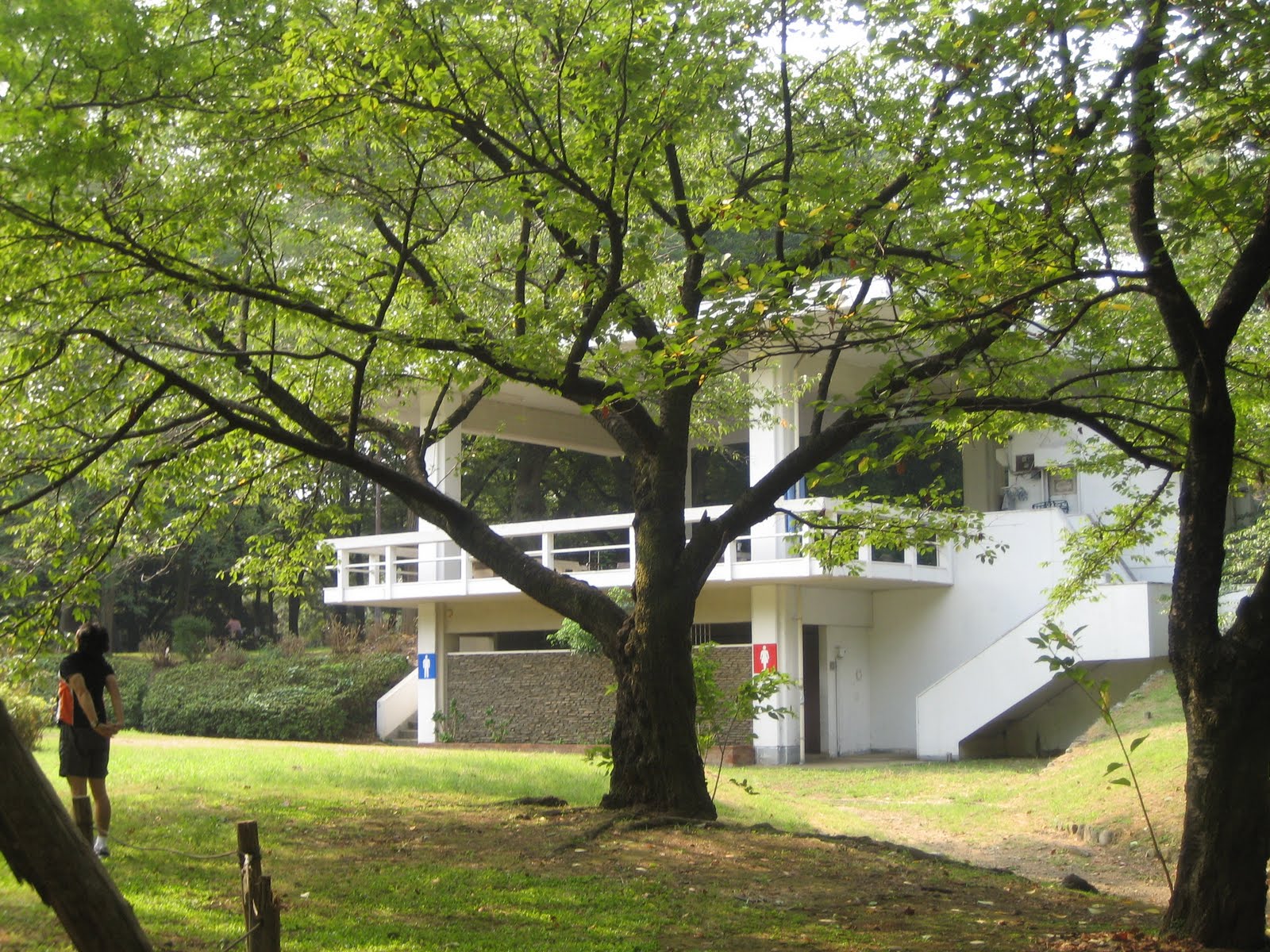
next is another wooded area i love near the famous public park bathroom designed by famous Finnish architect, Saarinen, i think, but i should double check this.
and now for the bathroom:
above the bathrooms is this balcony area with chaise lounges always occupied by folks.

next, i get to my one of my favorite hilly side trails, mostly soft dirt, gravel, and leaves, with the cacophonous serenade of cicada and crows. why crows? this is the part of the park that is most deeply wooded and shaded, and there are a shocking number of homeless people living in makeshift encampments.  it is a case of "out of sight, out of mind" as most Japanese would be shocked to see this large number of homeless people camping out, unless you frequent the park, you would have no idea. it is not in the news or media.  from a missionary person i met, i learned a few things. these homeless people are really tidy, use the public restrooms, get water for bathing needs from the fountains, and many work. they just cannot afford housing in Tokyo.  there is, as in all japan, an orderly hierarchy even among the homeless campers.  there is a leader or shogunate kind of guy, his immediate underlings who keep order, then the others allowed to have a piece of turf in their park, and where there are that many people with food, there are crows. dozens of crows, raucous noisy birds, and Tokyo crows scare me. they are huge, well-fed, and on steroids, i think. i avoid eye contact less they view me as a protein source. they are clever, these crows, and they will be here when we are gone.  now, all throughout yoyogi, sadly, you will see homeless people camping out, but the outliers are not part of the "group" in the desirable part of the park to be homeless, and worse are those just sleeping on benches and wherever they find shade. 

here is the first incline toward the homeless encampment in Yoyogi.


not a great view as i run by. but, these homeless are neat, tidy, recycling, and they are not the nyc-style alcoholic/addict or schizophrenic that you meet. many are engaged with joggers or cyclists having discussions, and they are working with the park rangers to keep it clean and crow-safe.
there are at least thirty or so of these blue-plastic tents, and as i get to the top of the incline, you pass the homeless domicile of what i think must be the shogunate. this is not your typical homeless encampment.
this is really quite beautiful.  it so zen and balanced. there are hanging bamboo with plants growing in them, a walkway lined with perfectly placed pine cones or matsubokuri, and a wooden door, and immaculate. there is calligraphy. this person has talent. why is this person here? is it choice? it is hard for me to think that the guy living here could not be more successful in life or i wonder why did he end up here.

and with that, i do a few loops, head back over the highway, and head to home.  pounds lighter, dangerously dehydrated.  maybe i go to shibuya swim club where i hear you can swim for next to nothing...

Coming next: Chapter Six: Whales' Tale or If you are Japanese, skip this blog.

Chapter Four: Niko's School

Niko goes to the American School in Japan.  It looks like a small private college and costs as much.  This school goes from kindergarten to high school.  It has its own indoor pool, tennis courts, a real football field with a goal post, and a playground with a climbing wall.  His PE class has swimming!  The food is really good, too. There is even a small kiosk that serves caffeine, as in latte, espresso, and cafe americano!!! No wonder Niko's favorite classes are in order:  PE, recess, and lunch.  Here is a view of the school.  Here is a shot of Niko's school and a picture of the kiosk menu that serves up those lattes and espressos to junior and senior high school students. My kind of school! Get them started early on the caffeine kick.  And the price is a bargain at 220 yen (reference point: Staba or Starbucks charges double that so i really do not mind attending those parental conference things now since i know that, at the very least, a good espresso awaits me).


Such enlightment! If only i had espresso access as a high school student.....


it looks corporate because it is...

Many of the kids at the school have parents working for major American corporations, often investment banks.  When you look closely, all the equipment is sponsored by fortune 500 companies with in-roads into Japan.  A father that i met works for Microsoft which funds 35 spots in the school.  Most of these kids' tuitions are part of the ex-pat perks and packages, and the bill for Niko's tuition asks first for the company to which the bill should be sent. That would be my checking account.  Mari, as a UN employee, did get an education allowance in NYC so more than half of Niko's tuition was covered by the UN, but that education grant is never given to Americans at the UN since it is their home country, and the expectation is that the child can get schooled in the public sector. Logically, in Japan, Mari's home country where both she and Niko have Japanese passports, the expectation is that he attend the local public school that is a five minute walk from our home, and no subsidy.  I guess that this is a prelude to the pain that parents feel when those college tuition payments are due.  Luckily, i can do this in 4 painful installments, as i do better with long chronic pain in small amounts (think marathon training).  You may wonder why Niko cannot do public school. Mainly, he would be too far behind in written Kanji. It could be done, but it would be so painful for him to catch up.  He is at second grade kanji level and he would need to learn of all second, third, and fourth grade kanji in one year, a tall order.  And, the reality is that he will return to the states. More important that he gets oral fluency and cultural immersion.  The American School does have japanese and he is in a native speaker class. Already he is much more fluent reading kana in manga, so this is great. 
 
Niko is on the swim team.  There is an "A" team and "B" team. He is on B-team which is good. The A-team has many more meets and practices, and the time commitment is onerous. Since we just arrived here, we would only opt for that B-team as the practices are only twice a week, and there are only 2 weekend meets. We went to a "practice meet" which meant getting up on Saturday at half past 6am.  I guess that Vermont parent with kids in hockey know all about this special weekend pain of losing a late sleep-in.  And, the meet lasted until 3pm, and you, as a parent, are given all kinds of things to do--timer, announcer, etc-- so you cannot exactly just try to sleep quietly in a corner.  Here are a few pictures:
 
 
Getting ready for the 50 meter backstroke.
Next race coming. Coach has advice.

and they are off...i mean, really, timers, and even a scoreboard. this is just fourth grade, i say. i was happy to play dodge ball on a blacktop and tetherball...the good old days.


Niko is in the center lane with a lead.  Some of these kids were really competitive. Niko just wanted to fool around, and there were kids of 6 and 7 who were crying most of the time.
it is official. 50 meters crawl in just under 48 seconds for Niko. 

Stay tuned for Chapter 5:  Yoyogi Koen (Park): The Daily Jog/Flog

Friday, September 10, 2010

Chapter Three: Gomi Day (Garbage Day) and Risto's Meltdown (Nearly Nuclear)

Gomi. A simple four letter word that arouses terror in all who live in Tokyo, both native and gaijin (non-japanese foreigners living here). This is simply the japanese word for garbage. Ah, but all things japanese have so many layers to them. Tokyo being one of the most densely populated places on the planet needs tight rules on recycling and garbage disposal, and the japanese love their rules. these garbage rules are about as simple to understand as a tokyo subway map (an upcoming blog).  The instant we moved into our new home, this was the first sheet of paper the landlady gave to us with many admonishments about how important it was to obey their gomi rules, and stick this up on the refrigerator.  Here is her helpful guide to me:

So, this lists all the possible types of gomi, how they are grouped together, what kinds of bags they can go in. there is "namagomi" which is food scraps (i.e. banana peels), plastics that are recyclable, other recyclables like newspapers are separated and tied in bundles different from cardboard that must be tied in a bundle, and those plastic recyclables must be in a transparent plastic bag, and then there is a crate just for tins and bottles, and these are disposed of on different days so that mondays are recyclable plastics, tuesday and friday are combustible garbage including food bits, and on saturdays, the first and third weeks of the months are metalic things, broken glass, etc, all of which have rules about how to dispose of them, and in the bottom righthand corner, a number to call where you must pay for the privilege to haul away big garbage items like furniture. "sodai gomi", which is slang for a useless husband.

well, here is garbage day with all the garbages lined up and hidden under yellow plastic to make it less of an eyesore. 

and for a close-up...

well, i stress about this daily. having to put it all in the right containers, and we have a bunch of gomibaco (garbage bins), one for each of the different gomi, and i have to wash the plastic sometimes. it is all confusing. now i know why all the expats look for apartments where the superintendent organizes all their garbage.

today, the ultimate shame for me.  i thought that i was being the consummate good husband. i woke up, cut fruit for our breakfast, had coffee going, started the laundary, and brought out the two bags of gomi. i was the perfect japanese okusan (housewife).  so proud of myself. then mari tells me how one of those bags was recyclable plastics, wrong gomi, wrong day.  the horrors!! i had to quickly run outside, rummage through the bags like a homeless person in nyc and get the wrong gomi back, and then i had to walk home, tail between my legs like a bad little doggie, as all these neighbors watched, these passerbys too, all with eyes bearing down on the bad gaijin who still cannot master the gomi rules despite the helpful guides with all those pictures...then when i got home i just had my nuclear meltdown about how the stress of gomi day was putting me on the verge of a nervous breakdown. yell, yell, yell, shout, shout, shout, but seconds later, it passed. lesson: do not under any circumstance attempt to do gomiday without the morning shot of espresso....

Chapter Two: Shopping and Noise

We live in Kobama-todai (short for tokyo daigaku or tokyo university). The closest, biggest shopping station is shibuya, which is featured in "Lost in Translation". This is a 5-pointed star intersection and just a chaos at all times filled with so many people, always, that you feel like you are part of a large antfarm.  It is thee trendy spot for teenagers, so it caters to that group. Except for the huge electronics store, a cheap but good store for household things, and tokyo foodshow, shibuya should be avoided in my opinion but from where we live, all subways go through shibuya, so we are there often.

Here is street level shot of shibuya at a quite time of day. Does not do justice to the multitudes and masses.


Shibuya is famed for the Hachiko story of the dog that waited dutifully at the trainstation everyday at the appointed time waiting for his friend to come, and he continued loyally long after that person passed away. Well, i clearly wanted to see this more than niko, who seemed rather thrilled to venture here.


Clearly, someone has outgrown this story...Nearby Shibuya is the superchic Omotesando which is Les Champs Elysees de Tokyo lined with the most expensive and chicest stores. Great little cafes. Nothing affordable but that is not the point. This photo is for a friend, and alas, i do not know Monsieur Mikimoto, but he has a store on this little block.


Close to omotesando is takashitadori, the famed locale of the Harajuku garu ("garu" is girls in japlish) and the anime characters and this is a street where everyday is halloween. It attracts all kinds. We watched a bunch of harajuku garu dressed like emo (goth types who like to cut themselves) doing a square dance.


then you have folks making political statements. there were no takers, after all, it was nearly 100F and so humid, everyone had sweat-stained shirts, including the sign holders. please. you couldn't pay me...


Niko, naturally, has a favorite store on this Omotesando, called Kiddyland.  It is a compressed Toys R Us, as this is Tokyo after all.  Crammed along all available wall and floor space are millions of toys, all the collectible japanese plastic toys that drive kids and parents to distraction.  pokemon, bakugan, bey blades, all are here. niko spent an hour deliberating between two plastic-metal spinning tops (a bey blade), while i had to listen to the noise of millions of toys beeping, honking, whizzing, firing, and kiddies crying, begging, yelling in a mishmash of every language known to man as this is a prime kiddie tourist locale. here is niko in front of his "mikimoto" in profound deliberation...

why noise and shopping? well, no matter the store, there is noise, noise, noise. the yamadadenki store near shibuya is the best place to buy electronics. however, the experience even took its toll on my personal buddha, Mari, whose patience was sorely tested. there is the ear-splitting racket, and then there is the process. you cannot simply go to the electronics store, pull an item off the shelf and head to checkout line. no, you first must go speak to a concierge who tells you how you will shop. then, you get a pad and paper from one of his junior colleagues who explain that you must write down the make, model, and number of the product in which you are interested, then you come back. when we are writing down such products, we had a question about an electric mixer, but the closest store attendant was just the coffee maker expert. he stands waiting, poised and on alert, just to answer coffee maker questions. no, we had to ask the mixer expert who was nowhere to be found. then, once that is done, you go back to concierge, they will check on what things are available. that takes time, too. then, you can go to payout, but that sometimes takes an hour as they ask whether you want to get points for your purchases. at this point, we abandoned ship, took our white sheet of paper to expedite our return trip, but seriously, no products and fours hours wasted.  when we bought tv, that took 4 hours, and it took over an hour to pay, and i could not have bought anything, as you have to fill out your address in japanese or kanji, especially if you want delivery. for some products like cell phones, you cannot get these if you are here as a tourist, and since my "status" is being processed, poor mari gets stuck with all the schlepping around....no wonder this economy is in a state of decline, the inefficiency of buying electronics was mind-blowing.

But, there is a silver lining.  FOOD! oishimono (delicious things!).  me and my stomach are in seventh heaven. Below Shibuya is Tokyo Food Show, and it is just filled with the freshest seafood, meats, veggies and fruit, lots of special japanese foods, gelati, french breads and patisserie, and it is all so perfect in taste, and the best are the bento boxes. here are some sample pics:


this sashimi is as good as it looks, and that was dinner tonight!
 What follows are the world's most expensive bagels at nearly 2 dollars apeice, but each are individually wrapped and made that day, and the world's tastiest but smallest doughnuts, which are all the size of an Oreo cookie.
 Here come the doughnuts:
I will post more food over the coming weeks.
Stay tuned for tomorrow's exciting adventure where i do battle with trash and recycling.....

Chapter Three: Gomi Day (Garbage Day) and Risto's Meltdown (almost nuclear)

Thursday, September 9, 2010

J-Life: Risto, Mari, ja Niko in Tokyo. Chapter One: Concrete and Sun

Background Facts:
Mari started her new job as Director of UN Information Bureau in mid-July while Niko was in Vermont summer camp and while i worked at UVM.

Sun:

We all flew into Tokyo at the end of August just in time to experience Tokyo's unprecedented, record-shattering heat wave (joy!). For the first two weeks, until yesterday's typhoon rains, the temperatures have hovered around 36C for high (nearly 100F) and lows in upper 20s C (mid to upper 80s) and always with incredible humidity that reminds me of Costa Rican rain forest. I think that Tokyo's latitude parallels Rome and not the equator, but you could have fooled me.
If this is global warming, then we all need to relocate to Newfoundland or Greenland. Maybe Nunavit and its eskimos need an MR center or a telerad outsource service.

Concrete:

When we came to Tokyo, we had to stay at a hotel in Shibuya, close to Mari's office as she needed to work. The first pictures are from the hotel room on the 21st floor with a great panorama of Tokyo. It is Manhattan on steroids. So much larger than NYC. There are several clustered downtowns with high rises, and the geographic area is much greater, and it is estimated that nearly one-third of the nation lives in Tokyo and the adjacent cities. As far as the eye can see, it is concrete and asphalt.


this is the view to the left, above.


this is the view center, dead on.


this is to the right. you can make out Tokyo Tower and the Mori buildings in Roppongi. 

All this asphalt and concrete radiate that heat, and walking outside is stepping into a sauna. Running in this heat is a challenge, more details to come. For another perspective, here is Niko plastered against the 21st story window like a bug.yes, he is mr. shibuya.

these first few days in the hotel are tough.  jetlag and that 13 hr time differnece from vermont do not help.


luckily, there is caffeinated help.  now, there is a huge sticker shock here. that little 8oz package of lavazza at home that goes for less than 7.50 is at least 12 dollars here with the exchange rate. the starbucks ("staba") are ubiquitous here, but the iced cafe americano largest size here is like the smallest size back home and about 5 dollars, so what is a caffeine addict to do? you go to these convenience stores like Family Mart, 7 Eleven (more upscale here) or Lawson's and you find an entire shelf of starbucks and theier competitors in cans and cups for a fraction of their going street value like less than 200 yen or 2 and a half bucks. Paydirt!


so many choices, so little time.

OK. stay tuned for chapter two:  Noise and Shopping.  These are one in the same here.